Tuesday, 21 March 2017

Myth Busting-Dark Chocolate


Chocolate has always been known as a rich and decadent treat that we should not overly indulge in. But what if I told you that chocolate, specifically dark chocolate, has some benefits to you and your health. Here are some dark chocolate facts I bet you didn't know!


1. Dark chocolate has more cocoa and less sugar that milk chocolate and white chocolate, making it the more nutritious choice than the rest. Excess sugar in the diet can be stored as fat.

2. Dark chocolate has a large amount of antioxidants in it. Antioxidants prevent free radicals from forming in the body which can help us to prevent diseases like cancer and other cardiovascular diseases.

3. Dark chocolate is full of heart healthy fats, monounsaturated and polyunsaturated fats, which can aid in the reduction in the rish of cardiovascular disease.

4. Dark chocolate has a high amount of amino acids, which are the building blocks of proteins. When we have an adequate amount of amino acids in our body, the easier it is for our bodies to build new muscle.

5. Dark Chocolate contains dopamine, a neurotransmitter. When dopamine reaches the brain, the pleasure centers are stimulated causing you to feel good. Thats why some people get a wash of good feelings after eating chocolate

Next time you're reaching into the pantry for chocolate, grab the dark chocolate for a tasty treat that has nutritional benefits as well. Just remember, everything in moderation! Eating a whole bag of Dark Chocolate morsels doesn't mean you will wipe out your risk of heart disease and cancer! You will probably just get a really bad stomach ache!

Tuesday, 7 March 2017

Put Your Best Fork Forward!


Natioanl Nutrition Month 2017


March is National Nutrition Month in the U.S! And, actually tomorrow is National RDN (Registered Dietitian Nutritionist) Day! So, you may be reading my articles to learn more about healthy eating, finding some recipes, or learning more about your body, but I wanted to take this week's post and talk about what a Dietitian is, a little history of nutrition and dietetics, and why you should visit a dietitian!

Let's start with a little history first

National Nutrition Month first started as a week long celebration of nutrition and encouraging people to eat healthy in 1973. Due to the great amount of interest that came with the week celebration and increasing public interest in nutrition, in 1980 it became a month long celebration. 

Careers in dietetics started around 100 years ago, with a focus in family and consumer sciences. From that point, dietetics has grown into it's own degree and now is becoming a master's level position in the near future. There are around 100,000 credentialed dietitians and Diet Techs worldwide, with the academy being the largest organization dedicated to food and nutrition professionals. Dietitians are now in hospitals, long term care facilities, out-patients clinics, pharmaseutical companies, wellness facilities, gyms, colleges, sports teams, etc. Dietitians can work in almost any field!

Image may contain: 2 people

What is a dietitian? 

one concerned with the promotion of good health through proper diet and with the therapeutic use of diet in the treatment of disease. The dietitian may work in a variety of settings, including hospitals and other health care agencies, schools, hotels,and other commercial institutions where duties include both food service administration and therapeutic nutrition services, ormay choose to enter the fields of education and research. Some dietitians practice independently either as consultants orprivate practitioners in the area of therapeutic dietetics.

Why should you see a dietitian/what can they do for you?

Anyone can call themselves a nutritionist, but only those with degrees from an accredited institution and completed the mandatory 1200 hour internship can be called a dietitian. A dietitian has credentials, a nutritionist does not! Dietitians have formal training and need to pass a very hard exam to be called a dietitian, a nutritionist does not. 

A dietitian can give you the highest level of nutrition counseling, they can give personally tailored advice to help you and your lifestyle, they can help you manage chronic diseases like hypertension, diabetes, and high cholesterol, they can give guidance for those with food allergies, intolerances, and sensitivities, and they can give you a real weight-loss program that will actually work! We work with athletes and pregnant women too! Skip the silly programs and yo-yo diets, and get a program that will actually work! Dietitians work for you and want to help you! 

Want to find a dietitian near you? Heres a link to the Academy of Nutrition and Dietetics website to find a Dietitian http://www.eatright.org/find-an-expert

Want to learn more about Marywood's nutrition and dietetics program?

https://www.facebook.com/Marywood-Student-Academy-of-Nutrition-and-Dietetics-SAND-705079016259746/

Thursday, 2 March 2017

Whole Grain Pasta Treat!

Looking for a little spice from a pasta recipe but not feeling marinara sauce? Spicy Thai Peanut Noodles have a great little kick and have color from vegetables. I whipped this up for the week last Sunday so I could snack on it all week. The sauce is just peanut butter, soy sauce, rice wine vinegar, cayenne and vegetable oil. The longer you let the sauce sit before you put it on the pasta and vegetables, the spicier the sauce will be! This salad is great warm or cold and a perfect to pack in your lunch. Use Whole Wheat pasta to get in some of your whole grains for the day.

Cut up some of your favorite vegetables to add a little crunch to this dish too! I added yellow bell pepper, snow peas, and scallions for color and texture.


Noodles with Spicy Peanut Sauce

1/3c Peanut Butter
3 Tbsp Vegetable Oil
3 Tbsp Rice Vinegar, distilled White Vinegar or White Wine Vinegar
2 Tbsp Soy Sauce
1/4 Tbp Cayenne, or more to taste
1 Teaspoon Sugar
1 Large Garlic Clove, Mashed, Smashed and Finely Chopped
8 to 12 oz Noodles

In a mixing bowl, combine all the ingredients expect the pasta. With rubber spatula or wooden spoon, work together until smooth and mixed. Let stand for at least 4 hours. Use to dress
 8-12 oz of chinese pasta or italian style pasta. Makes 2-4 servings

Sunday, 19 February 2017

Tomato Soup-Just Like Mom's But Easier!

Do you ever get that craving for some homemade tomato soup on a chilly February night? Well, I did last week! I was craving a grilled cheese with tomato soup, but I was not going to settle for any old canned tomato soup. I wanted the real thing! Instead of hopping on Pinterest, I actually made this recipe up myself! It was super easy and tasty, especially if you like a little chunky cream of tomato soup.

I started by taking out a large stock pot and melting 1/3 cup of butter with 2 cloves of minced garlic and one chopped shallot. I was going to use a little onion, but I really enjoy the complex flavor of shallots, and I had one sitting in my pantry ready to use! Let the butter melt down and start to brown the garlic and shallots until they are fragrant. Once browned and fragrant, add in a 28oz can of diced tomatoes and a 28oz can of crushed tomatoes. Stir and let simmer over medium heat for 20 minutes. When the 20 minutes are up, add in salt and pepper to taste, and 1 cup of heavy cream. Let the soup simmer for 10 more minutes, and serve with grated parmesan on top.

 I did't have any cheese to make a grilled cheese so I made two little garlic toasts to accompany the soup. Super easy and very tasty! This recipe would also be really good for meal prep too!

Wednesday, 15 February 2017

Easy Energy Boosting Bites!


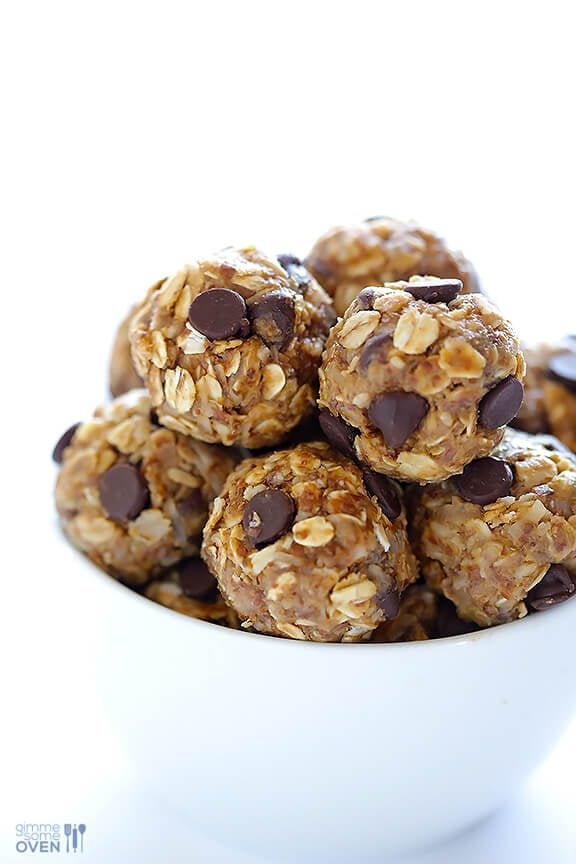
No-Bake Energy Bites -- quick and easy to make, naturally sweetened with honey, and SO delicious! Perfect for a quick breakfast, snack, or even a healthy dessert. Gluten-free / Vegan. | gimmesomeoven.com

As usual, I was scrolling through pinterest this weekend and kept seeing quick recipes for energy bites. I am all about convenience when eating, as long as its wholesome and nutrient dense. I am a very busy girl so something quick like an energy bite for before the gym, is perfect! These are good for anyone though, they are customizable, easy to make, and perfect for an on-the-go lifestyle. I mixed together a cup of rolled oats, 1/2c peanut butter (could be substituted with any nut butter of preference), 1/2 chocolate chips (could be any type of chip of preference), 1tsp vanilla extract, and 1/4c honey or Agave nectar. Its best to throw the peanut butter and honey into the microwave for 15 seconds to make it a little thinner and easier to mix. After mixed together, put the mixture into the fridge for 30 minutes. Then form into small balls and put either in the fridge or freezer for 30 minutes to set mixture. Take out and enjoy!

This is just a basic recipe I used. I would have added some chopped nuts and maybe seeds if I had some on hand, but they still taste great and are very nutritious without them.

1 ball will have about 80 calories, with 6g of protein! This snack is perfect for athletes too, because there is a great balance of protein, carbs, and fats to give you long lasting energy to help you perform to the best of your abilities.


Image taken from Give Me Some Oven

Monday, 13 February 2017

How to: Carbohydrate Loading

Carbohydrate loading is a process that has been done for many years and in many different ways. I have even tried to do this a few years ago before I learned about the proper way to do it in sports nutrition. When I played lacrosse, we would often have pasta parties the night before a big game and we all thought that we were really carb loading. However, eating an excessive amount of carbs less than 24 hours before an event or game isn't going to make much of a difference than if you didn't have any extra carbs at all. In order to properly carb load and have it help you in the event, the process needs to start about a week before the event or big game. Let's break this down step by step using an individual who weighs about 135 pounds, or 61.36 kilograms. To find out how much you weigh in kilograms, take your weight and divide it by 2.2.

Like I said before, carb loading needs to start about a week before the event.

7 days prior to the event, you should be having about 5g/kg of body weight in carbs. So, for our 61.36 kg individual, they should be having about 307 grams of carbohydrates for days 1, 2 and 3. You find this number by multiplying your weight in kilograms by 5, and voila! With the 307g of carbs being ingested, you should be engaging in intense training. This will help to deplete the current glycogen stores in your muscles in order to make way more carbohydrates.

Days 4, 5 and 6 will be lighter training days to ensure that the carbohydrates are being stored for the event just a few days away. On these days, the 61.36kg individual will be having 10g/kg of carbohydrates, or 614 grams of carbohydrates. Multiply your weight in kilograms by 10, and you'll have the grams of carbs you should be having for those three days. I know this sounds like a lot, and it is, but these three days are vital to fill up your stores for the big event.

Finally, the day before the event. This day will have light to no training at all for the event, and the individual should be ingesting the normal amount of carbohydrates. So a 61.36kg individual will be having about 250g to 357g of carbohydrates.


One of my favorite carbs is pasta, and I was so excited when I was introduced to Barilla's Protein Plus Pasta. In one serving, you're getting all the carbs you need, plus 17g of protein! It really packs a punch and helps to make sure you're getting more protein in your diet. You'll also be getting 7g of fiber, which aids in digestion, and Omega-3 fatty acids, which help support your heart. I would definitely suggest this to anyone trying to carb load. You'll get those carbs,protein, Omega-3s, and fiber in one easy source.


Thursday, 9 February 2017

Who am I and what is The Road to Being an RD?


Since I originally started this blog, the following has increase substantially and I thought it was time to reintroduce myself, talk about this blog, what my objectives are and what is in store for the future!

A little bit of history-

I started to become interested in nutrition and dietetics back when I was in ninth grade. I developed an eating disorder and was sent to seen a dietitian to help with my food habits and intake. From the minute I walked into her office, I felt so at ease and was so intrigued with everything she had to say to me. I looked forward to my meetings with her every other week and worked really hard on my own nutrition to make me healthier. After I finished sessions with her, I expressed to my parents how much I was interested in nutrition and what a dietitian does. I was able to go in and shadow her for a day, which was one of the most enlightening experiences ever. I met with diabetes patients and bariatric surgery patients, heard their stories and goals, and helped them plan their success. Through connections with my mom's work, I was able to meet up with a dietitian from the county Office of Youth and Aging. She is such an inspiring woman who has such a passion for nutrition and helping people. She gave me more exposure to the community side of nutrition and nutrition education. I worked with her at her office over summer on senior citizen farmer's market coupons, meals on wheel, and building community relations which could lead to more outreach programs. 

When it came time for me to start deciding on where I wanted to go to school, I focused on schools that have Coordinated Programs in Nutrition and Dietetics. Dietetics degrees are broken down into two programs, the Coordinated Program and Didactic Programs in Dietetics. Both lead to a degree in dietetics, but the Coordinated Program lets you do your 1200 hours of supervised practice in your junior and senior year to make you eligible to sit for your credentialing exam right after graduation. A didactic program has you finish your degree, then after graduation, apply to a national pool of internships (which has a 50% match rate), get matched and then go do the supervised practice. Upon completion of the supervised practice, they are then eligible to sit for their credentialing exam. Marywood University is one of the top schools in the US for health professionals and has one of the top dietetic programs. Marywood was a perfect fit from the moment I stepped on campus. I applied and got in and I absolutely love it. The class size is perfect, the facilities are state-of-the-art, and the professors are top notch. The first two years of schooling are mostly general education classes that the university requires, with some classes within your major. I took a Basic Foods Lab, Social and Cultural Foods, Food Science, Computers in Dietetics, Nutrition I, Life Cycle Nutrition, Nutrition Education, and Food Science. All of these classes were great bases for what is covered in the junior and senior year, which is when the course load is more intensive. The beginning of the second semester of sophomore year was when applications and interviews happened for the Coordinated Program, and I was one of the ten students selected, of those who applied, to be a part of the program. Junior Fall began supervised practice rotations at a community nutrition setting and a food service setting. Classes corresponded with what we were doing at our sites which made learning what to do so much more fun. Sports nutrition was also part of the curriculum for the semester, which really intrigued me. Junior Spring is mostly nutrition classes as well, like Medical Nutrition Therapy, Research in Dietetics, and Food Service Management II, with rotations in Food Service Management. 

Future Plans
After I graduate next May, I plan on studying for my credentialing exam, applying to grad school and looking for a job. I am really interested in sports nutrition and how proper nutrition can effect how someone performs in a competitive setting, so I am planning on getting my Master's Degree in Exercise Science. This will help me better understand how the body uses energy to fuel itself and what needs to be done to increase performance. From there I will work my way up through the ranks and hopefully achieve a position with a professional athletic team or work for a college as their sports dietitian.

What Brings Me to Blogging?
Well, I started this blog, technically, back in April of 2015 with a brief introduction post and overview of nutrition and wellness. However, I did not really start blogging much until the winter/spring of last year. I was kind of bored one day, so I picked it up and just started! I like to talk about what ever comes to my mind that day, or I ask my mom for some help with ideas. I try to make each post a little different, and to not repeat topics or areas twice in a row. That's why you really won't see two blog posts back to back talking about a recipe. I want to appeal a wide variety of audiences, give you new information that you may not be able to find anywhere, and debunk some myths. 

What's in-Store?
I want to continue to offer a wide variety of articles, covering many topics. I want to keep trying new recipes and posting my results and how it tasted for you guys, and maybe do makeovers of old classic recipes. Eating clean doesn't have to taste bad! I hope to also offer more series posts pertaining to  different topics, like heart health, diabetes, meal prep, and more. I also want to do a few posts featuring a guest blogger! There is a lot in store for The Road to Being an Rd, and the possibilities are endless. I am always open to suggestions and working to cater to your needs and interests. Stay tuned!